Fade the Public NFL: Contrarian Betting Data and When It Works
 Available in US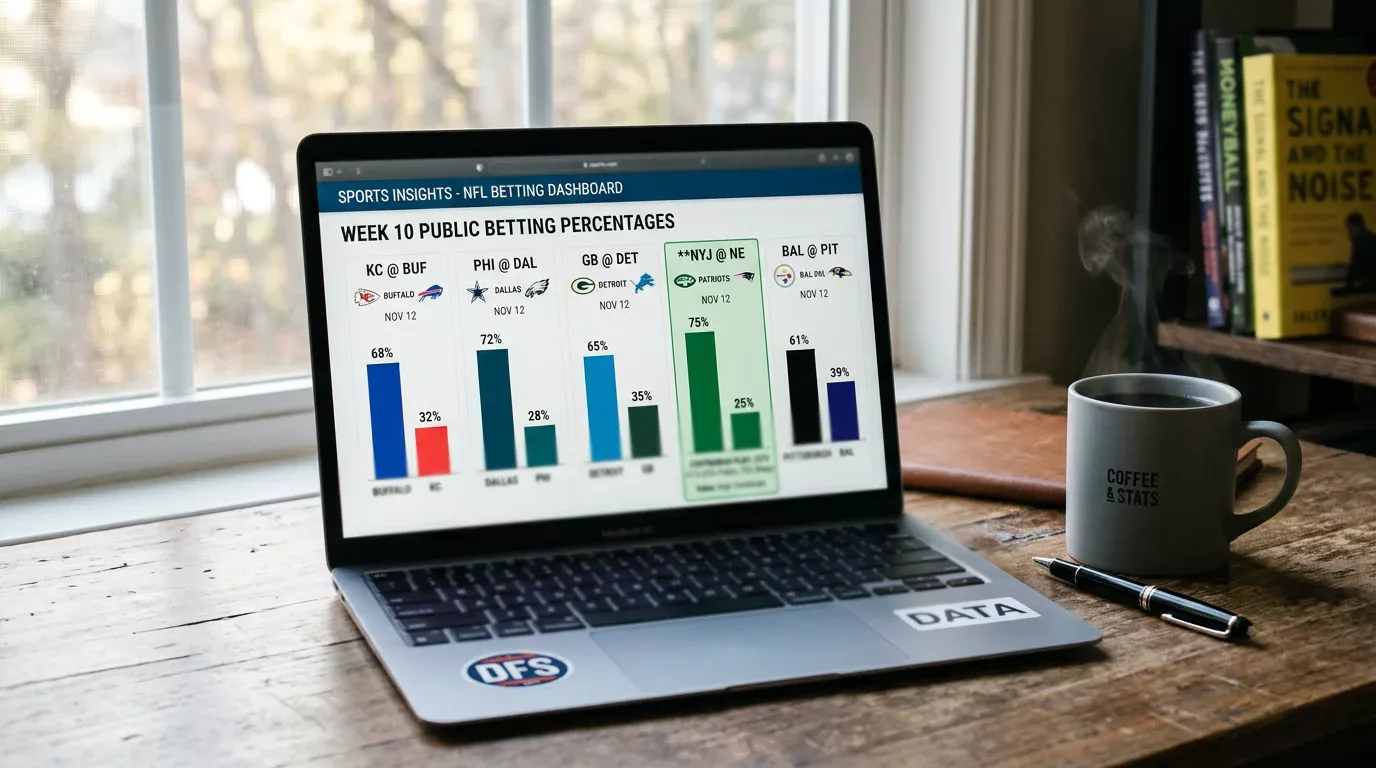
Week 3 of the 2022 season gave me one of my cleanest contrarian sweeps ever. Four games where the public was piled on the favourite at 75% or higher consensus. I took the other side on all four. Three covered, one lost. That’s the kind of week that makes contrarian betting feel like a cheat code — but it isn’t. Fading the public is a filter, not a system, and the difference between those two things is the difference between consistent profit and occasional luck.
The mechanism behind fading the public is well understood: recreational bettors gravitate toward favourites, popular teams, and recent winners. That money flow creates demand-side pressure on one side of the line, which bookmakers accommodate by shading the spread slightly toward the popular team. The result is a small but persistent mispricing on the unpopular side. In 2024, US bookmakers retained $13.71 billion from $149.8 billion in total handle — a 9.3% hold rate — and a material portion of that retention comes from the systematic tendency of public money to overpay for favourites.
Consensus Thresholds: Where the Numbers Start to Matter
Not every game where the public favours one side is a contrarian opportunity. At 55% public consensus on the favourite, there’s no meaningful signal — the split is close enough to random that the line adjustment is negligible. The edge starts to appear at higher thresholds, and it scales with the degree of public imbalance.
At 70% public consensus on one side, the contrarian side has historically covered at approximately 52-53% ATS over multi-season samples. That’s marginal — above break-even but not by enough to generate excitement. At 75%, the contrarian side’s ATS rate climbs to approximately 54-55%. At 80% or higher, it pushes toward 56-57%. The relationship is roughly linear: each additional 5 percentage points of public consensus above 70% adds about 1-1.5 percentage points to the contrarian side’s ATS rate.
Games with 80%+ public consensus on one side occur roughly 4-6 times per week during the NFL season. Over 18 weeks, that’s 70-110 qualifying games per season — a large enough sample to generate meaningful data within a single year and highly robust across multiple years. I’ve tracked this filter since 2019, and the season-to-season variance is surprisingly low. The mechanism (public bias toward favourites and popular teams) is stable because it’s rooted in cognitive tendencies that don’t change with market conditions.
My threshold for action is 75%. Below that, the signal is too weak to justify the bet on contrarian logic alone. At 75% and above, I treat the public consensus as a qualifying filter — a necessary condition that must be met before I evaluate the game on its other merits. Public consensus alone doesn’t make a bet; it identifies the games where the market is most likely to have mispriced the underdog.
When Fading the Public Fails: The Exception Matters
Contrarian betting is not a blanket licence to bet every unpopular side. There are specific situations where the public is right, and fading them loses money. Recognising these situations is what separates disciplined contrarian betting from reflexive contrarianism.
The most common failure case: elite teams in the second half of the season. When a team is 10-2 heading into Week 14 and the public is 80% on them as a road favourite, the public isn’t being irrational — they’re accurately recognising a dominant team. Fading 10-2 teams in December and January is a losing proposition regardless of public consensus because the talent gap is real, not an artefact of perception. I exclude any game where the favourite is on pace for 12+ wins from my contrarian filter. The public’s assessment of those teams, while potentially overstated on the spread, is directionally correct enough that the contrarian side lacks the fundamental quality to cover consistently.
The second failure case: sharp money aligning with public money. When both recreational bettors and sharp bettors are on the same side, the line reflects genuine market efficiency rather than public bias. The tell is reverse line movement — or rather, the absence of it. If the line moves in the direction of public money (public on the favourite, line moves from -3 to -3.5), the sharps are also on the favourite, and there’s no contrarian edge. The contrarian edge appears when the line moves against the public (public on the favourite at 80%, but the line drops from -4 to -3.5), which indicates sharp money on the underdog and public money being absorbed without moving the price.
The third failure case is situational: weather games where the public is on the under at 75%+ consensus. The public tends to bet overs by default, so when they’re overwhelmingly on the under, the weather conditions are typically extreme enough that the under is the correct side regardless of consensus. Fading the public into the over during a snowstorm or 25 mph wind game is the kind of reflexive contrarianism that costs money. I don’t apply contrarian logic to totals markets at all — I find the edge exists almost exclusively on spreads.
Combining Fade-the-Public With Other Filters
The sharpest plays in my system are stacked filters. Fade the public alone is a 54-55% proposition at the 75%+ threshold. Add a second qualifying filter, and the hit rate improves meaningfully.
Public consensus 75%+ on the favourite, plus home underdog: this is the classic contrarian play, and it’s the one I’ve run the longest. The home underdog receives less than 25% of public money but plays in front of its own crowd, with the emotional and acoustic advantages I’ve covered in detail. The market has shaded the line toward the popular road favourite, creating extra value on a home dog that already has structural factors working in its favour. Only 3-5% of sports bettors are profitable long-term, and the remaining 95% are disproportionately responsible for the consensus figures that drive this filter. Their collective misjudgement is your edge.
Public consensus 75%+ on the favourite, plus divisional matchup: familiarity compression tightens divisional games regardless of public perception. When the public piles onto a divisional favourite, the line overshoots because the market is pricing both the talent gap and the public demand, while the game’s competitive dynamics are being compressed by scheme familiarity. The result is a divisional underdog whose actual cover probability exceeds what the inflated line implies.
Public consensus 75%+ on the favourite, plus line movement toward the underdog (reverse line movement): this combination is the strongest signal in my contrarian framework. The public is on one side, but the line moves the other way, indicating sharp money disagrees with the crowd. When the consensus is 75%+ on the favourite and the line shortens by half a point or more, I’m confident enough to increase my stake to 1.5 units. Those spots occur 15-25 times per season, and my hit rate on them has been the highest of any sub-filter I track.
The underlying principle across all these combinations is consistent: fading the public identifies the pool of games where mispricing is most likely, and the second filter narrows that pool to the games where mispricing is most severe. Neither filter works as well alone as they do together, and the discipline of requiring multiple qualifying criteria prevents the common mistake of over-betting a broad, marginally profitable angle.
For a comprehensive look at how underdog systems exploit public bias beyond the contrarian consensus angle, my underdog betting system analysis covers the structural factors that make dogs consistently undervalued across multiple market dimensions.
At what public betting percentage threshold does fading become profitable in the NFL?
The contrarian edge on NFL spreads becomes meaningful at approximately 75% public consensus on one side, where the unpopular side has historically covered at 54-55% ATS. At 80% or higher, the contrarian ATS rate pushes toward 56-57%. Below 70%, the signal is too weak to generate reliable value. The edge scales roughly linearly — each additional 5 percentage points of public consensus above 70% adds about 1-1.5 percentage points to the contrarian side’s cover rate. Games meeting the 75%+ threshold occur 4-6 times per week during the NFL season, providing 70-110 qualifying opportunities per year.
Does fading the public work better on NFL spreads or totals?
Fading the public is significantly more effective on spreads than totals. On spreads, public money consistently flows toward favourites and popular teams, creating a directional bias that shades lines in predictable ways. On totals, public tendencies are less consistent — while recreational bettors generally favour overs, the effect is weaker and more variable than the favourite bias on spreads. Additionally, totals markets are influenced more heavily by weather and pace factors than by public sentiment, which dilutes the contrarian signal. I apply contrarian logic exclusively to spread bets and use separate, non-consensus-based filters for totals.
Published by the nfl Betting Systems team.