NFL Spread Betting System: ATS Edges With Multi-Season Proof
 Available in US
I spent my first three seasons betting NFL spreads the way most people do — gut feeling, a few injury reports, maybe a glance at power rankings. The results were exactly what you’d expect: a slow, grinding leak of money that felt like progress because I’d occasionally nail a big weekend. It took a proper spreadsheet and 400 tracked bets before I saw the truth in black and white. I was hitting 49.8% against the spread. Not terrible. Not profitable. Just noise dressed up as knowledge.
The spread market is the beating heart of NFL wagering. The $30 billion in legal NFL handle during the 2025 season flows disproportionately through point spread bets, and that volume creates something valuable — inefficiency. Not everywhere, not always, but in specific, repeatable spots where the market’s pricing mechanism breaks down. The break-even win rate at standard -110 juice is 52.38%. That number sounds close to a coin flip, and it is. But the gap between 50% and 55% is the difference between slowly going broke and building a genuine return on your bankroll.
This guide is about the spread systems I’ve tracked, tested and refined over nine years of professional analysis. Every system here comes with multi-season data, specific entry rules, and a clear explanation of why the edge exists — not just that it does. I’m writing for the UK bettor who already understands what a spread is and wants to know which spreads consistently misprice outcomes, and why those mispricings persist despite the market getting sharper every year.
Three systems stand out from the noise. Each one targets a different structural weakness in the spread market, and each one has survived long enough — across enough games — to merit serious attention. Let me walk you through them.
Table of Contents
- Road Favourites Post-Bye: The Rest Advantage That Keeps Paying
- Divisional Underdogs ATS: Why Familiarity Tightens the Margin
- The Low-Total Underdog Filter: Stacking Conditions for a Sharper Edge
- Closing Line Value and Spread Efficiency: Measuring What Matters
- Applying Spread Systems in the UK: Timing, Odds and Practical Steps
- Frequently Asked Questions About NFL Spread Betting Systems
Road Favourites Post-Bye: The Rest Advantage That Keeps Paying
Back in 2019, I was convinced that bye weeks were a wash — teams rest, sure, but the line accounts for that, right? Then I ran the numbers on road favourites coming off bye weeks and nearly spat out my coffee. Since 1999, road favourites after a bye have gone 94-63-4 ATS — a 59.1% cover rate, good for +24.7 units and a 15.7% ROI. That’s not a trend. That’s a quarter-century of data laughing at the efficient market hypothesis.
The logic holds up under scrutiny. You’ve got a team talented enough to be favoured on the road — already a high bar — coming off two weeks of preparation. Their opponent has played the previous week and had a standard short turnaround. The rested favourite has extra time to install new wrinkles, heal nagging injuries, and review film. Meanwhile, the market systematically undervalues this rest advantage because casual bettors anchor to home-field advantage as the dominant factor.
What makes this system particularly robust is that it filters for quality on multiple axes simultaneously. The team must be good enough to be favoured away from home. They must have the bye-week rest advantage. And they must be facing a team on standard rest. Each filter independently increases win probability, and the combination creates a convergence of edges that the spread struggles to fully price in.
I’ve broken this down by conference, and the results remain strong across both the AFC and NFC, though NFC road favourites post-bye have historically shown a slightly higher cover rate. The divisional sub-split is particularly interesting — when the road favourite is also playing a divisional opponent, the familiarity factor adds another layer of preparation advantage during that extended bye-week window.
Here’s a worked example using decimal odds for UK bettors. Say you identify the Buffalo Bills as a 3.5-point road favourite at Cincinnati after their bye week. Your UK bookmaker offers the spread at 1.91 (the decimal equivalent of -110). You stake GBP10. If Buffalo covers, your return is GBP19.10 — a GBP9.10 profit. At a 59.1% historical cover rate, your expected value per bet is roughly GBP0.82. Run that across an 18-week season where you might find 6-8 qualifying games, and the maths starts to compound meaningfully. For a deeper breakdown of how bye-week timing interacts with scheduling fatigue, I’ve covered the full rest-advantage analysis in the bye week betting system guide.
A word of caution: sample size matters. Sixty-one qualifying games per decade sounds substantial, and it is, but individual seasons will vary. I’ve seen years where post-bye road favourites went 3-5 ATS. The edge is real over hundreds of games, not over any single Sunday.
Divisional Underdogs ATS: Why Familiarity Tightens the Margin
Every NFL team plays six divisional games per season — two against each rival. I used to treat these as regular matchups with a rivalry sticker slapped on top. Then I pulled the ATS data and realised I’d been ignoring one of the most consistent edges in the sport.
Since 2019, divisional underdogs have posted a 314-270 ATS record — 53.8% with a 3.4% ROI. That might not sound dramatic next to the post-bye system’s numbers, but context changes everything. Non-divisional underdogs over the same period went 520-509 ATS, which is 50.5% — essentially a coin flip with juice attached. The 3.3 percentage point gap between divisional and non-divisional dogs is enormous in a market where 2% separates profitable bettors from the rest.
Academic research backs up what the numbers suggest. Corey Shank’s study across 14 NFL seasons, published in the Journal of Economics and Finance in 2019, identified divisional familiarity as a genuine market inefficiency. Teams that face each other twice a year develop schematic counter-strategies that compress talent gaps. The worse team knows its rival’s tendencies intimately — formations, cadences, blitz packages, red-zone plays. That knowledge doesn’t make them better overall, but it makes them better against that specific opponent, and the spread doesn’t fully account for this narrowing effect.
Jeff Hochman, an NFL betting analyst at SportsLine, has described his focus as researching systems with a proven track record of generating profits, specifically targeting systems with win rates of at least 60%. Divisional underdogs don’t quite hit that bar across all conditions, but they form the foundation of several compound filters that do. The divisional tag isn’t a system by itself — it’s the first building block of something more powerful.
Think about it from the bookmaker’s perspective. They set lines based primarily on overall team quality, adjusted for home-field advantage, injuries and public perception. What they can’t easily price is the intangible of coaches who’ve studied 30+ hours of recent film on their specific opponent, players who know their rival’s snap count and audible patterns, and a locker room that treats divisional games differently regardless of the standings. These factors show up in the data as tighter games and more covers for the dog.
The second meeting between divisional rivals within a season often produces even tighter margins, as both coaching staffs have a full game of current-season data to adjust from. If you’re only going to track one sub-filter within divisional underdogs, the late-season rematch is the spot where familiarity reaches peak value.
The Low-Total Underdog Filter: Stacking Conditions for a Sharper Edge
If divisional underdogs are the foundation, the low-total filter is the accelerant. I stumbled onto this combination almost by accident — I was cross-referencing my underdog ATS database with totals data, looking for something else entirely, when a pattern jumped off the screen.
Underdogs in games with a posted total of 42 points or fewer have gone 205-150-10 ATS since the 2018-19 season — a 57.7% cover rate. That alone is a strong signal. But narrow it further to divisional matchups with a low total, and the numbers become genuinely striking: 84-57-4 ATS, a 59.6% cover rate. Nearly six out of ten covers. Over 145 games. Across six seasons.
The mechanism is straightforward once you see it. Low totals indicate that oddsmakers expect a compressed, grind-it-out contest — games decided by field position, turnovers and red-zone efficiency rather than explosive scoring. In these environments, the talent gap between teams shrinks. A team that can’t outscore a superior opponent in a 48-point shootout absolutely can hang with them in a 38-point defensive battle. Running the ball, controlling the clock and forcing punts are equalising tactics, and underdogs in low-scoring games employ them by design.
The divisional overlay amplifies this effect. You’ve already got two teams that know each other’s schemes cold. Add a game environment that favours defensive execution and ball control — areas where scheme familiarity matters most — and you’ve stacked three independent filters that each tilt probability toward the underdog. The spread, priced primarily on overall talent differential, consistently fails to absorb all three factors simultaneously.
One thing I’ve learned the hard way about combining filters: more isn’t always better. Every additional condition you add reduces your sample size. At 145 qualifying games across six years, the divisional-low-total-underdog filter sits right on the edge of statistical comfort. I wouldn’t add a fourth condition without very strong theoretical justification, because you’d be carving the dataset so thin that random variance could masquerade as signal. Three filters with clear causal logic and a decent sample — that’s the sweet spot where data-mining risk stays manageable and the edge stays real.
Practically, identifying qualifying games is simple. Check the week’s totals — anything at 42 or below qualifies. Cross-reference with the divisional schedule. If the underdog is at home, you’ve got an even stronger confluence, but the filter works for both home and away divisional dogs in low-scoring environments. The key discipline is waiting for the setup rather than forcing bets into weeks where no games qualify.
Closing Line Value and Spread Efficiency: Measuring What Matters
Two years into tracking my spread bets, I had a 56% win rate over a 200-bet sample and felt like I’d cracked the code. Then I calculated my closing line value and the feeling evaporated. I was winning, but I was consistently betting at prices worse than the closing line. In other words, I was getting lucky, not getting value. Within six months, my win rate regressed to 51% and the profits disappeared. CLV told me the truth months before my bankroll did.
Closing line value measures the difference between the odds you locked in and the final odds at market close — the last price available before kickoff. The closing line, particularly from sharp-origin books, represents the market’s most efficient estimate of true probability. If you consistently place bets at better prices than the closing line, you have a genuine edge. If you don’t, your win rate is living on borrowed time regardless of how good it looks right now.
Here’s how it works in practice. You bet the Kansas City Chiefs at -3 on Tuesday evening. By Sunday kickoff, the line has moved to Chiefs -4. You got a full point of value — your CLV is positive because you captured a price the market later deemed too generous. Alternatively, you bet the Chiefs at -3 and the line drifts to -2.5 by kickoff. Now you’re holding a worse number than the market’s final assessment, and your CLV is negative. Over hundreds of bets, positive CLV correlates strongly with long-term profit, while negative CLV predicts erosion no matter how hot your recent run feels.
For UK bettors, tracking CLV requires capturing both your entry odds and the closing odds from the same market. Pinnacle’s closing lines are the industry benchmark because their book accepts sharp action and lets the market find equilibrium. Even if you’re betting with a UK-licensed operator, compare your entry price to Pinnacle’s closing number. A simple spreadsheet with columns for your odds, Pinnacle’s close, and the calculated CLV percentage gives you the single most predictive metric of whether your spread betting is genuinely skilled or merely lucky.
The uncomfortable truth about CLV is that it exposes a dynamic most bettors prefer to ignore: sharp lines get sharper every year. As data availability improves, as modelling sophistication increases, and as books get better at identifying and limiting winning accounts, the window for capturing CLV on spreads narrows. This doesn’t mean edges disappear — the systems I’ve outlined in this article have survived precisely because their edges are rooted in structural market features rather than fleeting inefficiencies. But it does mean that timing matters. Grabbing a spread early in the week, before sharp money moves the line, is increasingly the difference between positive and negative CLV.
Applying Spread Systems in the UK: Timing, Odds and Practical Steps
Running NFL spread systems from the UK throws up practical wrinkles that American guides never mention. I know this because I spent my first year using US-focused advice and kept running into friction — odds formats that didn’t match, line release schedules that assumed I was awake at 3am, and data sources that required a VPN to access. Let me save you the learning curve.
The UK sports betting market generates GBP2.48 billion in annual gross gaming yield, and while football — the round-ball kind — dominates, NFL coverage from UK bookmakers has expanded significantly alongside the growth of the London games and broader NFL viewership. Most major UK-licensed operators now offer full NFL spread markets, though depth varies. Some post lines by Tuesday afternoon UK time, others wait until Thursday or even Friday. For the spread systems in this article, early-week lines matter because that’s when you’re most likely to capture value before sharp money corrects the market.
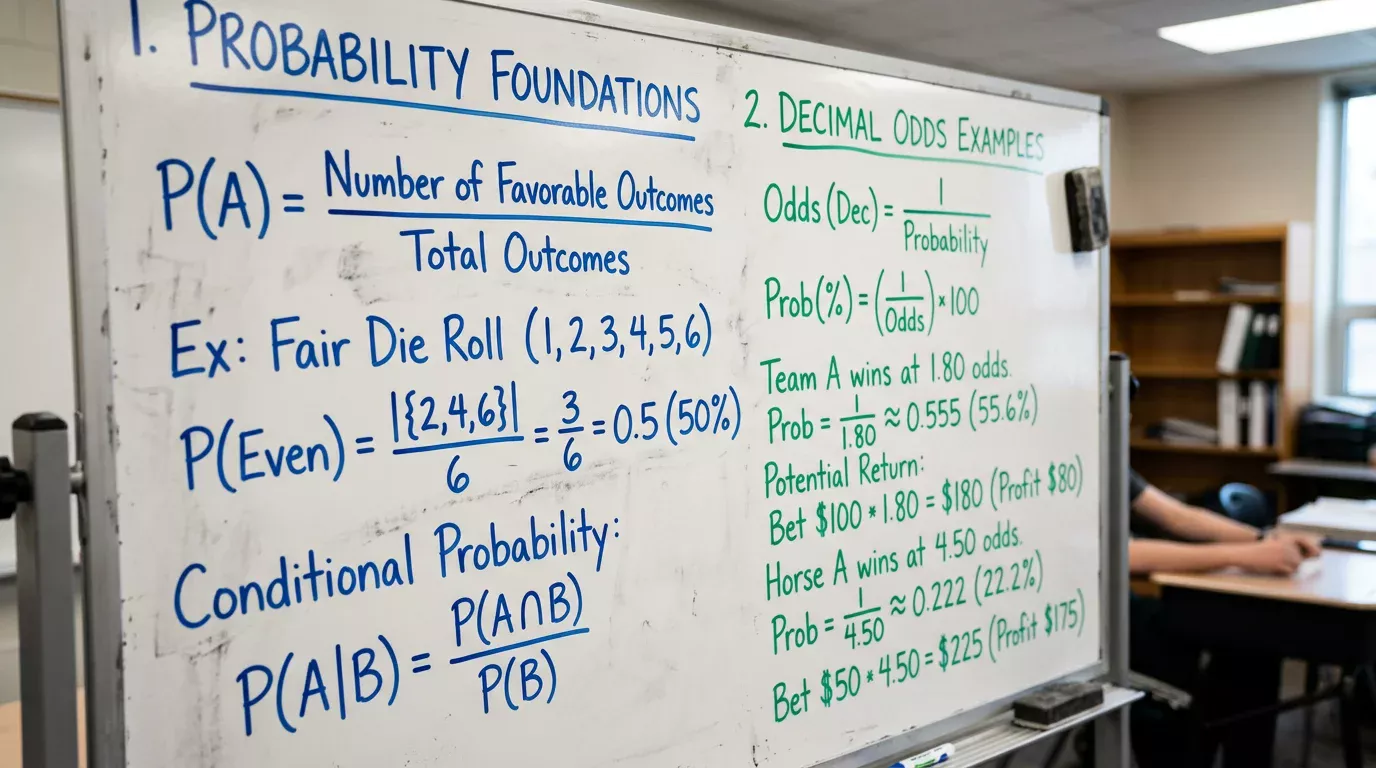
Decimal odds are your default format in the UK, and converting from the American odds used in most NFL data is essential. The standard -110 American line converts to 1.91 in decimal — meaning a GBP10 stake returns GBP19.10 on a win. For underdogs, a +150 American line becomes 2.50 in decimal. The conversion formula for negative American odds is: decimal = 1 + (100 / absolute value of American odds). For positive American odds: decimal = 1 + (American odds / 100). Burn these into memory or keep them pinned to your spreadsheet — you’ll use them every week.
Timing your bets around the NFL weekly cycle from a UK timezone takes adjustment. NFL lines typically settle into their sharpest form by Saturday evening US time, which is late Saturday night or early Sunday morning in the UK. If you’re targeting early-week value — particularly for the post-bye road favourite system — placing bets on Tuesday or Wednesday evening UK time catches the market before the heaviest sharp action. For Sunday afternoon kickoffs at 6pm UK time, you’ll want your positions locked by Saturday night at the latest.
ATS data is the lifeblood of spread system verification, and accessing it from the UK is easier than it used to be. Pro Football Reference provides free historical game results. For real-time ATS tracking, several US-based analytics sites offer free tiers with sufficient data for system monitoring. The critical habit is recording not just your bets and results, but also the closing line from a sharp-origin book — this gives you the CLV tracking that separates serious system bettors from recreational punters keeping a simple win-loss tally.
Line shopping across multiple UK bookmaker accounts is non-negotiable. Half a point on an NFL spread changes the outcome roughly 2-3% of the time, and when your entire edge is built on a 5-7% advantage over break-even, giving away points through laziness is indefensible. Maintain accounts with at least four UK-licensed operators and always check prices before placing. The Betfair Exchange offers an alternative pricing mechanism that occasionally provides better value than traditional fixed-odds markets, particularly on popular primetime games where exchange liquidity is highest.
Frequently Asked Questions About NFL Spread Betting Systems
What sample size makes an NFL ATS trend statistically meaningful?
A minimum of 200 qualifying games across at least three full seasons is the threshold I use before treating any ATS pattern as a potential system rather than noise. Below that, random variance can easily produce impressive-looking records that collapse under continued scrutiny. The post-bye road favourite system’s 161-game sample across 25 years is robust precisely because it spans multiple eras of NFL rule changes, coaching philosophies and market evolution. Single-season ATS streaks, no matter how striking, tell you almost nothing about a system’s long-term viability.
Why do divisional underdogs outperform non-divisional underdogs against the spread?
Divisional opponents face each other twice every season, creating deep schematic familiarity that compresses the talent gap. Coaching staffs invest disproportionate preparation time into divisional matchups, and players develop instinctive recognition of their rival’s tendencies — formations, snap counts, route concepts, blitz packages. This familiarity disproportionately benefits the underdog because it narrows the advantage the favourite holds in raw talent. The spread, priced primarily on overall team quality, consistently underestimates this narrowing effect. Since 2019, divisional underdogs have covered at 53.8% compared to just 50.5% for non-divisional underdogs.
How do I combine multiple ATS filters without overfitting?
The rule I follow is three filters maximum, each with a clear causal mechanism explaining why it creates an edge. Divisional underdog plus low total plus home-field advantage is a valid three-filter stack because each condition independently tilts probability toward the underdog through a different mechanism — familiarity, game environment and crowd support. Adding a fourth filter, like a specific day of the week or a coach’s record in certain months, typically carves the sample so thin that you are fitting noise rather than signal. If your combined filter produces fewer than 80-100 qualifying games across your test period, you have likely overfitted.
Do NFL spread systems work differently with UK decimal odds?
The systems themselves are odds-format agnostic — a 59.1% ATS cover rate produces the same edge whether you express the price as -110, 1.91 or 10/11. What changes for UK bettors is the practical execution. Decimal odds make expected value calculations slightly more intuitive since your total return is simply stake multiplied by odds. The more meaningful UK-specific factor is not the odds format but the margin embedded in the price. UK bookmakers sometimes offer slightly different margins on NFL spreads compared to US-origin books, so line shopping across your UK accounts can capture small but compounding value differences across a full season.
Created by the ”nfl Betting Systems” editorial team.