NFL Betting Model Machine Learning: Building a Predictive System
 Available in US
In 2020, I read a claim that a neural network NFL prediction model achieved 74.33% accuracy, compared to 68.67% for human experts. That number sounded spectacular until I started asking basic questions: what was the sample size? Was this tested on data the model had already seen? Over how many seasons? The answers, when I dug into them, were unsatisfying. That experience crystallised something I’d been circling for years — machine learning can improve your NFL betting, but only if you treat it with the same rigour you’d apply to any other system. Only 3-5% of sports bettors are profitable long-term, and building an ML model doesn’t automatically put you in that group.
What follows is a practical framework for building an NFL prediction model that’s honest about its limitations, grounded in reproducible methodology, and designed to complement — not replace — the systematic approach that drives everything else in my betting framework.
Feature Selection: What Data Actually Predicts NFL Outcomes
My first model used 47 features. It was terrible. Not because the features were individually wrong, but because many of them measured the same underlying signal. Passing yards per game, passing yards per attempt, and completion percentage all correlate heavily with each other — feeding all three into a model doesn’t give it three pieces of information. It gives it one piece of information three times, with added noise from each redundant feature.
Corey Shank’s academic research, published in the Journal of Economics and Finance across 14 NFL seasons, identified specific market inefficiencies tied to divisional dynamics and scoring patterns. That research didn’t use 47 features. It used focused inputs that captured genuine variance in outcomes. The lesson is clear: more data isn’t better data. Better data is better data.
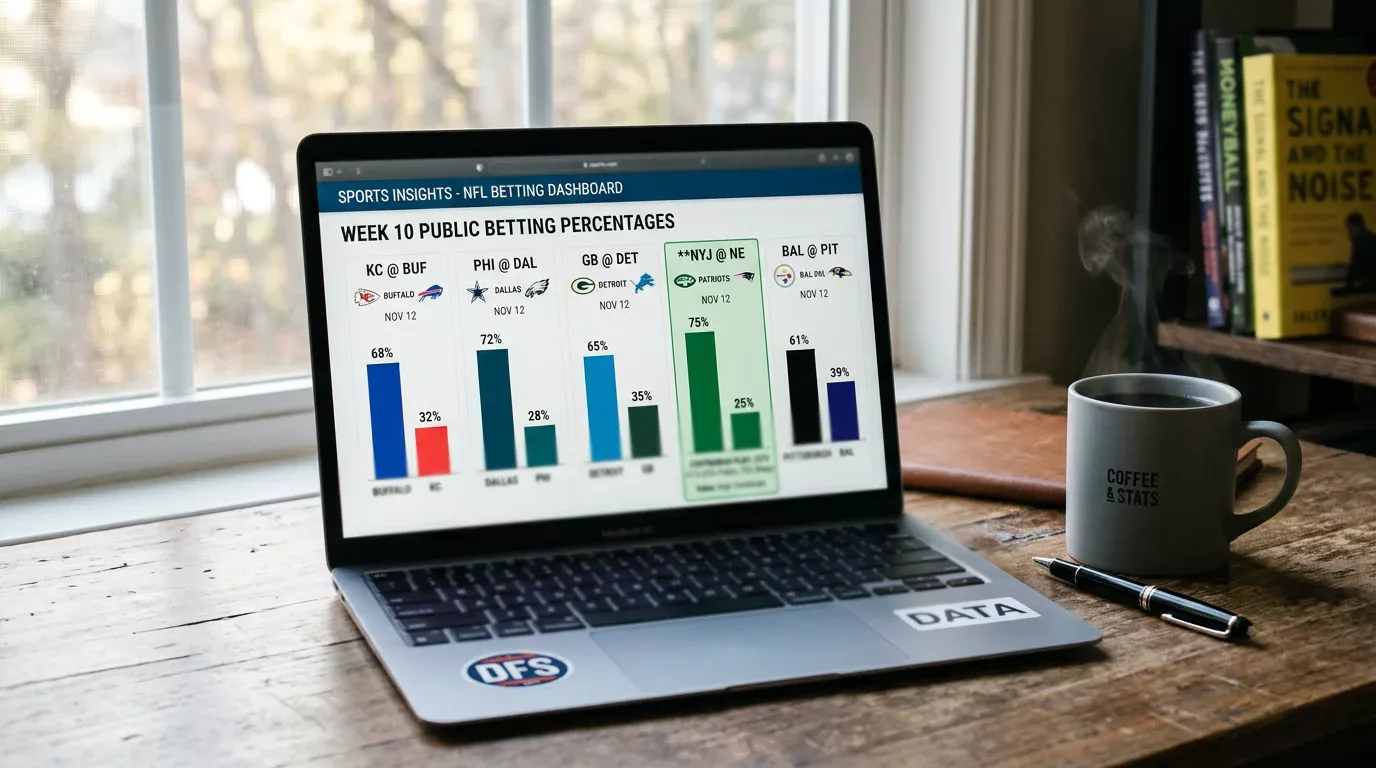
The features I’ve found most predictive fall into four categories. Efficiency metrics — EPA per play (offence and defence), DVOA, success rate — capture team quality better than volume stats like total yards. Pace metrics — plays per game, time of possession, neutral-situation pass rate — predict game flow and total scoring. Situational variables — rest days, travel distance, indoor/outdoor, divisional matchup — capture context the market sometimes underweights. And market signals — opening line, line movement, public betting percentage — incorporate the market’s own assessment, which is right more often than not.
Dimensionality reduction matters enormously. I use principal component analysis to identify which features carry independent information and which are redundant. After PCA, my current model uses 12 features — down from 47 in my naive first attempt. The accuracy dropped slightly on the training data but improved on out-of-sample data, which is the only metric that matters for betting.
Overfitting and Validation: Why Reported Accuracy Lies
“A worse model with a better strategy can easily outperform a better model with a worse strategy” — that finding from Czech Technical University researchers applies directly to the validation problem. The “better model” that achieves 74% accuracy on its training data is useless if it achieves 52% on games it hasn’t seen. Overfitting is the central enemy of sports prediction modelling, and most published accuracy claims are overfit.
Overfitting happens when a model learns the specific patterns in its training data rather than the generalisable relationships that predict future outcomes. In NFL terms: a model might learn that in 2019, Team X always covered when playing on the road after a loss. That pattern is real in the training data but reflects a specific combination of personnel, coaching, and schedule that doesn’t repeat. The model memorised noise and called it signal.
Walk-forward validation is the standard I apply. I train the model on seasons 1 through N, test on season N+1, then roll forward: train on seasons 1 through N+1, test on season N+2. This mimics the real-world constraint of betting: you can only use data from the past to predict the future. A model that performs well in walk-forward validation across 5+ seasons is demonstrating genuine predictive power, not pattern memorisation.
My current model produces a walk-forward accuracy of 54-56% against the spread across the eight seasons I’ve tested. That’s modest — it won’t win any Kaggle competitions. But 55% ATS on standard -110 juice generates consistent profit over a season. I’d rather have a validated 55% than an unvalidated 74%, because I know the 55% will hold up when actual money is on the line.
Practical Model Workflow: From Data to Sunday Bet Slip
Building the model is the intellectually satisfying part. Running it weekly and converting outputs to actionable bets is the operationally challenging part. Here’s my actual workflow, simplified but honest about the effort involved.
Data ingestion happens on Tuesday. I pull updated EPA, DVOA, and pace data from nflfastR (the play-by-play data repository) and Pro Football Reference. Injury reports aren’t finalised until Wednesday at the earliest, so Tuesday’s model run uses projected availability based on practice participation. I re-run the model on Thursday after the first official injury report and again on Saturday after final designations.
Each model run produces a predicted spread for every game. I compare the model’s predicted spread to the market spread. Games where the model disagrees with the market by 2 or more points go onto my watchlist. Games with 3+ points of disagreement are automatic bets if the line is available at the price my model expects. That threshold — 2-3 points of disagreement — is calibrated to my model’s historical accuracy. A model that’s right 55% of the time needs meaningful disagreement with the market to generate value; small disagreements are noise.
The Python ecosystem handles most of the technical work. Scikit-learn for the predictive model itself, pandas for data manipulation, and a simple SQLite database for storing historical results and model predictions. The entire pipeline runs in about 45 minutes per iteration, including data download, model execution, and output review. It’s not glamorous, but it’s reproducible and consistent.
One honest caveat: my model doesn’t outperform my qualitative analysis on every game. Where it adds value is in games I wouldn’t have analysed closely — mid-market matchups between teams I don’t follow, early-season games where I lack strong opinions, and totals markets where the model’s EPA-based pace projections capture scoring potential more accurately than my subjective assessment. The model is a tool that expands my coverage, not a replacement for the judgment I’ve developed over nine years.
What accuracy rate should I expect from a well-built NFL prediction model?
Against the spread, a validated model performing at 54-56% in walk-forward testing across multiple seasons represents genuinely strong performance. Claims of 70%+ accuracy are almost certainly measured on training data (overfit) rather than out-of-sample data. At standard -110 juice, 55% accuracy generates meaningful profit over a full season. The key metric isn’t reported accuracy but walk-forward accuracy — how the model performs on seasons it wasn’t trained on. Any model that hasn’t been validated through walk-forward testing across at least 3-5 seasons hasn’t proven anything.
How many seasons of data should I use to train an NFL ML model?
A minimum of 8-10 seasons provides enough data points (roughly 2,000-2,500 regular-season games) for stable model training without reaching so far back that the data reflects a fundamentally different version of the sport. NFL rule changes, roster composition norms, and offensive philosophy have evolved significantly, so data from before 2010 may introduce noise rather than signal. Use the most recent 10 seasons for training and validate on the 2-3 seasons that follow your training window. Re-train annually to incorporate the latest season’s data and drop the oldest season to keep the training window current.
Published by the nfl Betting Systems team.